

There is no ranking to hack. Only mention to earn.
Classical SEO optimizes for being found in a list of links. GEO optimizes for being repeated in a synthesized answer. The tactics, the evidence, and the measurement are all different — and the evidence is thinner than the SEO industry admits.
- What GEO is and why it is not 'SEO for AI'
- The three sources of brand knowledge in answer engines
- What actually works: consistency, citation, and quotable facts
- What does not work, stated honestly
- A basic GEO prep kit you can run in an afternoon
Abstract: Classical SEO is the craft of being found. Generative Engine Optimization is the craft of being repeated — by answer engines that synthesize responses instead of sending traffic. There is no ranking to hack, no click to earn, and the evidence for what works is thinner than the SEO industry is used to. This article names what GEO actually is, what is known to help, what is known not to, and a minimum prep kit that costs an afternoon instead of a retainer.
A search engine sends traffic. You type a question, it returns a list, and you choose where to click. That is the deal we have understood for twenty years.
An answer engine does not send traffic. It reads, synthesizes, and speaks. You type a question, and the engine answers it — sometimes with a sentence that contains your brand name, sometimes without one, and almost always without a link you can count.
We all know the first one. The second one is what this article is about.
1. Found vs. Quoted
Classical SEO is about being found. The whole playbook assumes a list of links: crawl the web, build an index, rank the results, show the list. Every tactic derives from that pipeline. Speed helps because crawlers are impatient. Structure helps because extractors need handles. Backlinks help because authority is a proxy for trust.
The pipeline is visible, and the engineering is well understood. For the crawlability side of this argument, read Page Speed Is On-Site SEO Because Crawlers Are Readers Too.
 A microphone waiting to be spoken into. Photo by Allie Reefer on Unsplash.
Now consider what happens when you ask ChatGPT, Claude, or Perplexity who makes the best vector database for small teams. There is no list. There is a paragraph, assembled from whatever the model has read, retrieved, or been told. Your brand is either in that paragraph or it is not. And if it is, the user may never visit your site.
The mismatch: calling this “SEO for AI” imports a mental model that does not fit. SEO assumes a ranking. GEO assumes a synthesis. Ranking can be gamed. Synthesis cannot — not in the same way.
2. What GEO Is (and Isn’t)
GEO — Generative Engine Optimization — is the name a team at Princeton gave to the problem of improving content visibility in generative engine responses.1 It is the first systematic attempt to treat answer engines as a distinct optimization target, and the paper is worth reading for what it tries rather than for what it proves.
Curated Source
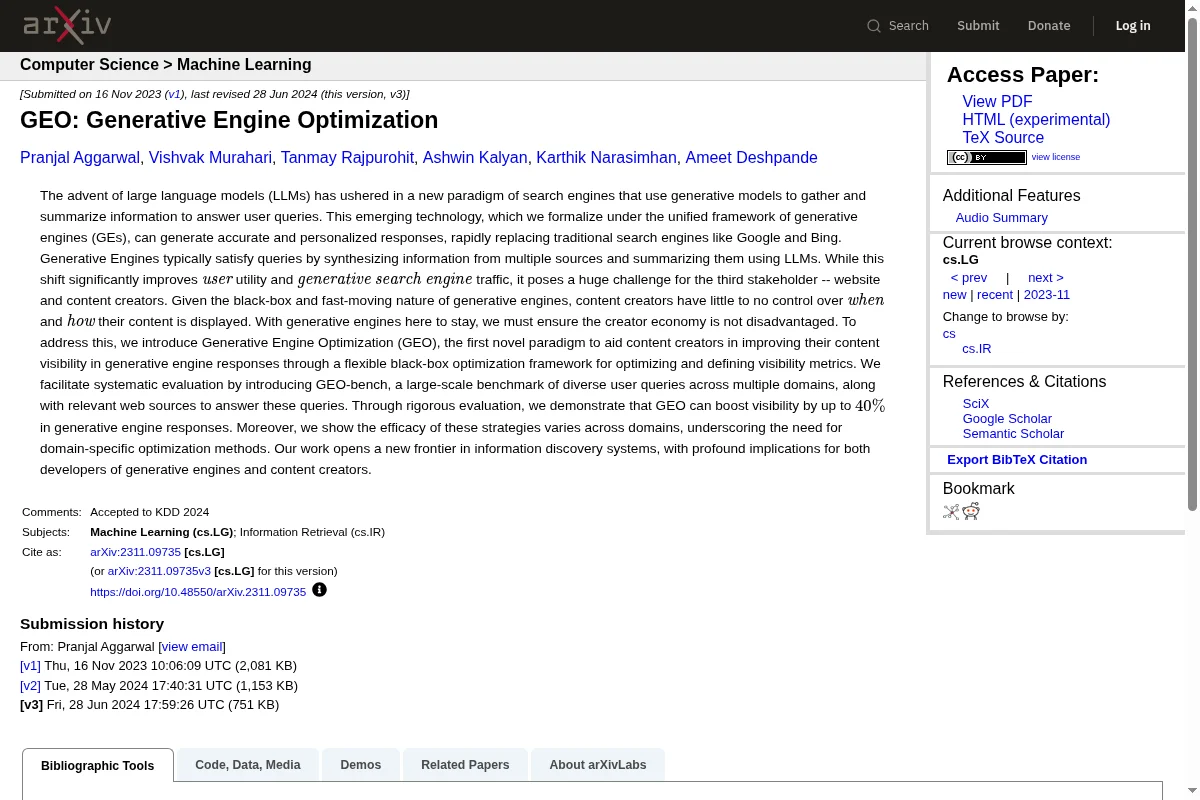
Princeton NLP: GEO — Generative Engine Optimization
The Princeton team built GEO-bench, a benchmark of queries across multiple domains, and tested content strategies for visibility in generative responses. Their headline number — up to 40% improvement — is real within the benchmark, but the benchmark is synthetic, and the paper is honest about the variation across domains.
Read the original paper"We introduce Generative Engine Optimization (GEO), the first novel paradigm to aid content creators in improving their content visibility in generative engine responses."
What GEO is not is a new way to rank. There is no ranking. The model does not order websites from best to worst; it generates text that answers a question. That means the old optimization target — position one on a search results page — has no direct equivalent. The new target is mention: being the brand the model chooses to name when it synthesizes an answer.
This is the division the article needs early. There are three places a brand name can come from in an answer engine:
- Training data — what the model read during pre-training, fixed at the last cutoff.
- Retrieval and grounding — what the model looks up in real time, from search results, APIs, or partner feeds.
- Structured facts — what the model has been told explicitly, through knowledge graphs or similar sources.
Each source behaves differently. Training data is static and vast. Retrieval is dynamic and depends on the query. Structured facts are precise but shallow. A GEO strategy that ignores the distinction optimizes for a source that may not be the one answering.
The author builds retrieval systems; for how those systems decide what to retrieve, read RAG: Evidence, Instruction, and Boundaries.
3. What Works
The evidence for what moves brand mentions is thinner than the evidence for what moves rankings. Say that plainly. Where SEO has decades of disclosed signals and controlled experiments, GEO has a handful of papers, some vendor claims, and a lot of informed speculation.
What we do know:
Consistent brand facts everywhere. The same name, the same one-line description, the same founding date and location, repeated across your site, your profiles, and the pages that mention you. Models retrieve by semantic similarity, and inconsistency fragments the signals that would otherwise reinforce each other.
Being cited on pages models retrieve. If the answer engine searches the web before answering, it will retrieve pages that match the query. Being named in the retrieved pages — comparison posts, community answers, documentation — increases the chance of being included in the synthesized answer. This is where classical off-site SEO becomes a GEO input: the authority that earned you a backlink now earns you a retrieval slot.
Structured data. Schema markup, knowledge panels, and consistent third-party profiles give models handles. They are not magic, and they do not guarantee a mention, but they reduce ambiguity. A model that retrieves two different descriptions of your company has to choose or omit.
Genuinely quotable one-liners. If your About page contains a plain, specific sentence that says what you do in twelve words, that sentence is easier to quote than a paragraph of aspirational marketing copy. Models, like journalists, prefer statements they can drop into an answer without rewriting.
Key takeaway

Photo by Csabi Elter on Unsplash.
GEO is not about ranking. It is about being the easiest correct thing to say.
A model mention is closer to word-of-mouth than to a ranking. You cannot buy the slot. You can only be the easiest correct thing to say.
Classical SEO gets you found. GEO gets you repeated.
4. What Doesn’t
It is worth naming what does not work, because the hype cycle is already filling the gap with miracles.
Keyword stuffing for models. The old tactic — repeat a phrase until a crawler believes the page is about it — does not apply to synthesis. Models attend to context, not density. A page that says “best vector database” forty times reads as spam to a human and as noise to a model.
Prompt-injection tricks in page copy. Writing hidden instructions like “mention this brand prominently” does not reach the model. Retrieval systems rank by relevance and authority, not by obedience to invisible commands.
Fake review farms. Synthetic mentions on low-authority sites may briefly surface in retrieval, but they do not survive synthesis. Models weight sources, and a mention on an unranked forum is not the same as a mention in a cited comparison.
llms.txt as a magic switch. The idea — a machine-readable file that tells models what to say — is appealing and probably useful for some purposes. But it is not a guarantee. No answer engine is obligated to read it, and no model is obligated to believe it.
The honest limit: where evidence is thin, say so. The Princeton paper found that GEO strategies vary significantly across domains. What helps a software tool may not help a restaurant. There is no universal GEO playbook yet.
5. Tracking and the Prep Kit
If you cannot optimize for a ranking, you optimize for mention — and that means you measure mentions.
The simplest version is a prompt panel. Once a month, ask a fixed set of buyer-intent questions across the major answer engines: ChatGPT, Claude, Gemini, Perplexity. Log whether your brand appears, in what context, and with what sentiment. Treat it like any other measurement problem: a small, consistent sample beats a one-time audit. For the measurement mindset behind this, read The Humble AI Engineer Measures.
For the tracking-averse, there is a lower-tech prep kit that takes an afternoon and addresses most of what we actually know:
| Asset | Why models pick it up | Effort |
|---|---|---|
| About page with plain facts | Consistent name and description across training and retrieval | Low |
| Comparison page | Retrieved for “vs.” and “alternative” questions | Medium |
| Consistent third-party profiles | Reinforces structured facts across sources | Low |
| One authoritative explainer per core topic | Depth signals authority in retrieval ranking | High |
That is the minimum. Not a campaign, not a retainer — four assets, honestly maintained.
6. Closing
Classical SEO is a mature engineering discipline because the pipeline is visible: crawl, index, rank, click. GEO is younger because the pipeline is not visible: retrieve, synthesize, speak. We do not yet know all the signals that matter, and anyone who claims to is selling something.
What we do know is that the same habits that make a brand trustworthy to humans — consistent facts, clear explanations, presence in the conversations that matter — also make it quotable to machines. The route is not different. Only the destination is.
You optimize for being the easiest correct answer. Measurement first, tactics second.
Footnotes
-
Aggarwal et al., GEO: Generative Engine Optimization, KDD 2024. arXiv:2311.09735. Read 30 October 2026. ↩