
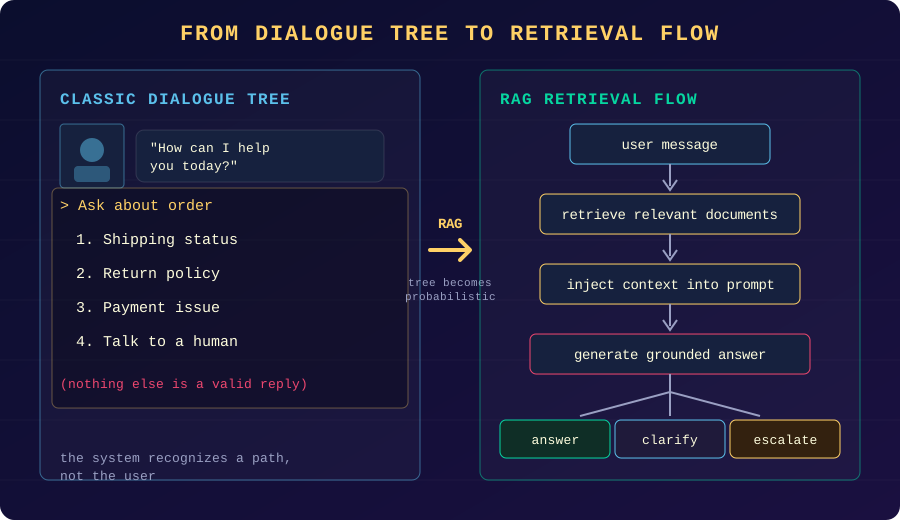
Abstract: The chatbot is framed less as an AI demo and more as a production interface where every answer has cost, risk, and context. The 90s adventure-game metaphor helps: classic dialogue trees gave authors control, while RAG turns the tree into a probabilistic conversation over documents. The article stays humble and concrete: what worked, what had to be constrained, and why real users care more about useful answers than model mystique.
Real users do not care that the system in front of them is artificial intelligence. They care, the way they care about a vending machine or a self-checkout lane, about whether it works.
They type the way people actually think — in fragments, half-finished questions, the shorthand of someone who already knows what they want and is just waiting for the interface to catch up. They click, they skim, they retry. They are not test cases, and they extend no special courtesy. They will not forgive a wrong answer just because something smart-sounding produced it.
That is what makes a Web UI chatbot such an honest engineering project. Behind the text box and the blinking cursor sits a production system where every reply carries a cost, a latency, a context, and a risk. The job is not to impress in a demo — it is to build a useful boundary between a person, a body of knowledge, and a model that is, often enough, confident for reasons that have nothing to do with being right.
From dialogue trees to retrieval
I keep coming back to 90s adventure games, because the comparison still holds.
Those dialogue trees were authored worlds: small, finite, every branch already imagined by a designer before the player arrived. Pick a line from the menu, and the writer already knew exactly where it led.
Ask about order
 -> shipping status
 -> return policy
 -> payment issue
 -> talk to human
Curated Source
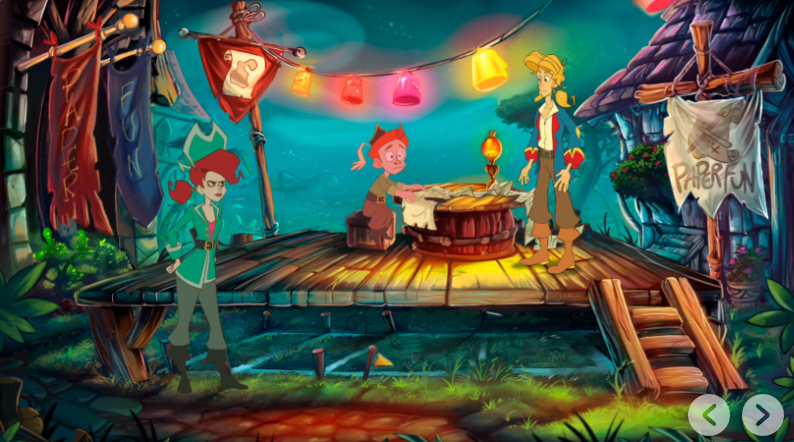
Adventure Gamers: The Secret of Monkey Island
The SCUMM interface went through its own iteration toward something a player could actually follow: clearer feedback, fewer dead-end verbs, and a conversation system that stayed readable even as it branched. A production chatbot needs the same kind of iteration.
"With beautiful VGA graphics, much-needed improvements in the interface, and an unparalleled sense of humor, The Secret of Monkey Island established its place in the adventure annals."View source context
There was integrity in that model — the author controlled every turn of the conversation, and nothing happened that had not been written in advance. But the limits were just as absolute as the control. Ask for something the tree had not anticipated, and the system had no graceful way to respond. It was not that it failed to understand you; understanding was never part of the deal. It recognized a path, or it did not — nothing in between.
RAG changes the shape of that tree. Instead of an author pre-writing every branch, the system reaches into a body of documentation in real time, retrieves whatever seems relevant, and lets the model assemble an answer from what it finds.
user message in the Next.js Web UI
 -> retrieve relevant documents
 -> inject context
 -> generate grounded answer
 -> decide whether to answer, clarify, or escalate
The tree becomes probabilistic. Branches are not fixed in advance — they are assembled each time from a library the author can keep extending, without ever having to imagine every question a visitor might ask.
That is a powerful shift. It is also exactly where the engineering work begins.
RAG is not magic
On paper, RAG is a recipe simple enough for an index card: documents go into a vector store, a search retrieves the relevant chunks, the model gets handed those chunks, and an answer appears in the Web UI.
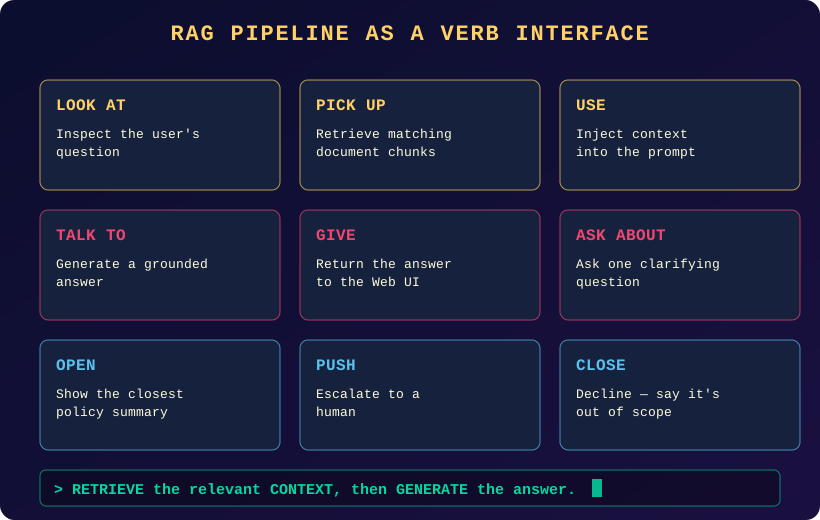
That is the diagram — the version that fits on a slide and looks like architecture.
The real system has to answer harder questions. Which documents, among everything in the store, are actually authoritative? How fresh are they, and who notices when they go stale? How big should a chunk be before it stops being a fact and starts being a paragraph with opinions in it? What happens when two retrieved chunks quietly disagree? What happens when the top result is almost right — close enough to be dangerous, not close enough to be true? How much context can a prompt hold before the answer gets slow, or expensive, or both? And, hardest of all: when should the chatbot simply decline to answer?
RAG does not remove product judgment from the system. It relocates it — into retrieval, into ranking, into the wording of prompts, into fallback behavior, into the slow accumulation of evaluation data. The judgment does not disappear. It just stops being visible in the diagram.
Latency changes the interface
A browser user will tolerate a spinner, briefly — the way one tolerates a red light. But a chat interface carries the rhythm of conversation, and if the assistant takes too long to reply, the system feels broken even when the eventual answer is correct. The pause itself becomes the message.
That means the architecture has to care about time the way a batch job never does: the responsiveness of the Web UI itself, the latency of the API route underneath it, how long retrieval takes, how long the model needs to generate, the overhead of the network, the cost of logging and tracing every step, and the retries and timeouts that exist precisely so the user never has to feel them.
The best answer is not always the longest one. Sometimes the useful answer is the short one — grounded, modest, and fast enough that it never breaks the rhythm of the exchange. For a production assistant, latency is not a backend metric tucked away in a dashboard. It is part of the product.
Prompt control matters
The prompt is not an incantation. It is closer to a contract — a short, written document the model is asked to honor, clause by clause, every time it speaks.
For a support assistant, that contract has to cover three situations: when the retrieved context is sufficient, when it is partial, and when it is missing entirely. A useful prompt policy reads less like encouragement and more like a legal text:
Use only the retrieved context for factual claims.
If the context is missing, ask a clarifying question or escalate.
Do not invent prices, policies, dates, or availability.
Keep the answer concise enough for a chat UI.
None of this is about teaching the model to sound polite. It is about narrowing the space of possible answers until invention becomes structurally difficult. A model should never be rewarded for sounding helpful while quietly fabricating the details a user is relying on.
Failure modes are product features
Every AI chatbot needs failure modes that are designed in advance — not discovered later by users who wander into them. In a RAG assistant, the ways things go wrong are depressingly predictable:
- no relevant document exists
- the retrieval match is weak
- two documents quietly contradict each other
- a policy has gone stale and nobody noticed
- the user’s request is ambiguous
- the question falls outside the assistant’s intended scope
- or, worst of all, the model produces an answer that is fluent, confident, and unsupported by any evidence at all
The naive system responds to this entire landscape by trying to answer everything anyway. The production system has options, and they are not complicated: ask a single clarifying question, surface the closest matching policy summary and let the user judge for themselves, offer a path to a human, say plainly that the answer is not yet in the documentation, or quietly log the question as a gap to be filled later.
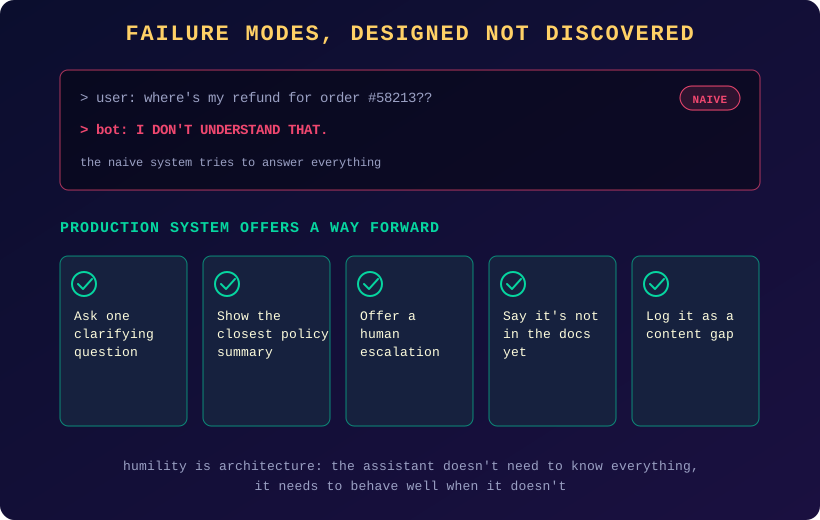
This is where humility becomes architecture. The assistant does not need to pretend it knows everything — it only needs to behave well in the considerable space of things it doesn’t.
Users care about usefulness, not model mystique
There is a gap between the questions an engineer asks and the questions a user asks. The engineer’s questions sound like this:
Which embedding model did you use?
How many tokens are in the prompt?
Is this LangChain or custom orchestration?
What vector distance metric powers retrieval?
The user’s questions sound like this:
Can I return this?
Where is my order?
What documents do I need?
Can I talk to someone?
That gap is not a failure of communication — it is two different vocabularies describing two different concerns. Engineers care about model choices, embeddings, chunking strategy, orchestration, and the Next.js interface that holds it all together. Users care about one thing: whether the assistant understands enough to help them, without wasting the small amount of time they were willing to spend.
The architecture matters, because it shapes the answer. But the architecture is not the product. The conversation is.
What worked
The strongest part of the project was the simplest combination imaginable: a familiar browser chat interface, paired with retrieval that kept the model honest. A Next.js Web UI keeps the interaction direct — a user types a question, sees an answer, and never has to leave the surface they are already on. No ticket form to learn, no dense FAQ page to search first.
RAG gave the assistant access to the entire knowledge base without requiring every possible path through it to be hand-authored in advance. Together, the two halves form a practical support layer: a user asks in their own words, retrieval finds whatever context seems likely to be relevant, the model turns that context into a concise reply, and the cases that remain unclear still escalate to a person.
The win is not that the chatbot feels magical — it does not, and it should not. The win is that the documentation itself becomes conversational, without losing the control that made it trustworthy in the first place.
What had to be constrained
The system needed boundaries, and it needed them everywhere. It had to know the shape of its own business domain, and stay inside it. It had to avoid claims it could not support. It had to keep its answers short, almost terse, and it had to treat a low-confidence retrieval as a different kind of answer — not a worse version of the same one.
A production chatbot, in practice, accumulates a small codex of such rules:
- answer only from retrieved context
- do not expose internal document text unnecessarily
- do not answer legal, medical, financial, or account-specific questions unless the system is designed for that scope
- escalate when confidence is low
- log unanswered questions for content improvement
- keep costs visible
None of this should be read as limitation. A constraint, in a system like this, is the reason the capability can be trusted at all.
The engineering lesson
Building the assistant made the same lesson visible again, as it always does: AI engineering is systems engineering, full stop. The model matters — but it is only one voice in a much larger conversation, one part of a loop that includes the documents themselves, the retrieval that finds them, the prompts that frame them, the latency budgets that constrain them, the fallback paths that catch what falls through, the evaluation that measures all of it, the logging that remembers what happened, the expectations the user arrives with, and the Web UI that carries the entire exchange.
When those pieces are weak, a stronger model can disguise the weakness — for a while. When those pieces are strong, even a modest model becomes genuinely useful, because the system around it is doing most of the work that people mistakenly attribute to the model alone.
The practical takeaway
A Web UI RAG assistant, in the end, is not really a chatbot. It is a small production interface stretched over the organization’s accumulated knowledge — and that means every single answer it gives is an engineering decision:
What context did we retrieve?
How confident are we?
What is the cost of answering?
What is the cost of being wrong?
Should we answer, clarify, or escalate?
The 90s adventure-game metaphor has stayed useful to me longer than I expected. Dialogue trees offered control at the cost of flexibility — every branch known, nothing else possible. RAG offers flexibility at the cost of that same control, and asks the engineer to rebuild it elsewhere: in retrieval quality, in prompt policy, in evaluation, in the quiet design of fallback paths.
The useful chatbot lives in the space between those two poles. Not a rigid tree, every branch foreseen and nothing else permitted. Not an unconstrained model, free to wander wherever fluency takes it. Something in between — a grounded conversation system, running in a Next.js Web UI, that respects the user’s time, understands the business context it operates within, and, above all, knows the shape of what it does not know.