Web 3.0 Traceability
Building Tamper-Evident Proof for SMEs Without the Hype
An implementation-focused guide for DACH and Western European B2B markets
Executive Summary
In Western European B2B markets, traceability is moving from "nice-to-have" to "expected"—driven by compliance, sustainability reporting, procurement scrutiny and supply chain risk management.
Many SMEs associate traceability with "blockchain" or "NFTs" and conclude it is either irrelevant or overly complex. In practice, most successful implementations do not lead with Web3 terminology. They lead with: tamper-evident documentation, verifiable product/service history and audit-ready evidence.
This article describes a pragmatic traceability architecture: what to expose publicly, what to keep internal, and how to implement verification layers that increase trust without increasing operational burden.

What Traceability Means in B2B
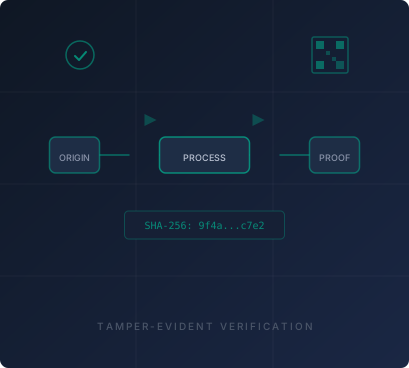
Traceability is the capability to reconstruct "what happened" across a product or service lifecycle: origin → process → handling → delivery → evidence.
For buyers, traceability reduces uncertainty. For suppliers, it reduces dispute cost and accelerates procurement clearance.
Two Traceability Types
- Product traceability: batch/serial identity, production events, certificates, logistics milestones, test results, maintenance records.
- Service traceability: delivery methodology, milestones, approvals, change history, artifacts, evidence of controls (security, quality).
Why Traceability Matters More Now
Western European procurement processes increasingly require evidence—not statements. "We are compliant" is less persuasive than traceable documentation that can be verified.
Traceability is especially relevant for:
- Manufacturing and industrial parts
- Food and agriculture
- Sustainable consumer goods
- B2B technology providers (security, quality, delivery assurance)
- Export-oriented SMEs entering DACH
"The Digital Product Passport aims to enhance transparency across product value chains by providing comprehensive information about each product's origin, materials, environmental impact, and disposal recommendations."
Myth: "Traceability = NFTs"
NFTs are one possible implementation detail, not the business requirement. The business requirement is: a tamper-evident verification layer.
What Buyers Actually Want
- Proof that documents were not altered after issuance
- Clear provenance (where a product comes from, or how a service was delivered)
- Auditable timestamps
- Consistency across public claims, certificates and internal records
- Low friction verification (ideally a QR code and a public page)
"Digital product passports will enhance supply chain management, ensure regulatory compliance, and help companies identify and mitigate risks related to authenticity and environmental impact."
A Pragmatic Traceability Architecture
A robust traceability system can be implemented with a simple, layered approach:
- Identity layer: unique product/service ID (batch, serial, project ID)
- Evidence layer: documents, certificates, test results, approvals
- Event layer: lifecycle events (created, tested, shipped, delivered, updated)
- Verification layer: hashes, timestamps, optional public anchoring
- Public presentation: QR code → verification page (human + machine readable)
What Goes on the Public Verification Page
- Product/service name + ID
- Issued certificates (downloadable PDFs where appropriate)
- Key dates (issuance, test, delivery, renewal)
- Responsible entity (company details)
- Verification status (valid/expired/superseded)
- Optional: a "proof" section that shows tamper-evident checksum and timestamp
What Stays Internal
- Supplier contract details
- Confidential process parameters
- Private audit notes
- Customer-specific pricing or sensitive operational information
Verification Mechanisms (From Simple to Strong)
Level 1: Document Integrity (Checksums)
Generate a cryptographic hash (e.g., SHA-256) for each certificate or report. Publish the hash on the verification page. This allows any recipient to confirm that a document was not altered.
Level 2: Timestamped Records
Add a trusted timestamp to the document or the hash (e.g., via timestamping services). This provides stronger evidence that the document existed at a specific date.
Level 3: Public Anchoring (Optional)
Anchor the hash in a public, append-only ledger. This can be implemented using a public blockchain or another immutable registry. The user experience remains the same: QR → verification page. The technical anchoring is a back-end proof layer.
"By making detailed product information publicly available, the DPP supports open data initiatives that emphasise transparency and accessibility."
User Experience: QR Verification That Procurement Actually Uses
The verification interface should be usable by non-technical stakeholders: procurement, compliance, quality managers and end customers.
UX Requirements
- Fast loading (performance matters for trust)
- Clear "valid/expired/superseded" status
- One-page access to key evidence (no friction)
- Machine-readable metadata (structured data for indexing)
- Accessibility and multilingual support (English + German where relevant)
The goal is not to impress with technology. The goal is to reduce verification effort.
Implementation Plan for SMEs (Minimal, Practical)
- Define identity: choose batch/serial scheme and data ownership
- Model evidence: certificates, test reports, approvals, renewals
- Define events: which lifecycle events matter to buyers
- Build verification pages: QR → public page per product/service ID
- Add integrity proofs: hashes + timestamps, optional anchoring
- Operationalize: processes for updates, renewals, revocation
Common Failure Modes (Avoid These)
- Publishing claims without evidence
- No revocation or expiry mechanism
- Inconsistent data across pages and documents
- Slow websites, complex UX, or broken QR flows
- Overengineering (complex chain logic for simple needs)
Conclusion
Traceability is not a "Web3 trend." It is a trust mechanism that is increasingly aligned with Western European procurement expectations and regulatory direction.
SMEs do not need hype or complexity. They need a structured, implementable verification layer that makes documentation and origin claims auditable and tamper-evident.
Implemented properly, traceability becomes a competitive advantage: it reduces risk, accelerates procurement and strengthens long-term partnerships.