Trust by Design
How Transparency, Traceability and Visible Governance Build B2B Credibility for Western European SMEs
Implementation-focused perspective for DACH, Benelux and Nordic B2B markets
Thesis
In Western European B2B markets, trust is not a marketing outcome. It is a risk-management requirement. For SMEs operating in or exporting to DACH, Benelux and the Nordics, a corporate website is no longer a digital brochure. It is a public risk profile—evaluated by procurement teams, compliance officers and executive decision-makers.
Trust is built systematically through five visible pillars:
- Certifications
- Transparency
- Traceability
- Visible governance
- Real, accountable teams
When implemented deliberately, these elements transform a website from a marketing asset into digital trust infrastructure.

The Changing Nature of B2B Web Presence
B2B buyers in Germany, Austria and Switzerland are highly risk-aware. Vendor selection processes increasingly include:
- Compliance verification
- ESG alignment checks
- Data protection review
- Supply chain scrutiny
- Corporate stability assessment
In this environment, design aesthetics alone are insufficient. A visually modern website without structural credibility signals creates hesitation rather than confidence.
The question is no longer, "Does the website look professional?" The question is: "Does this company demonstrate operational maturity, accountability and regulatory alignment?"
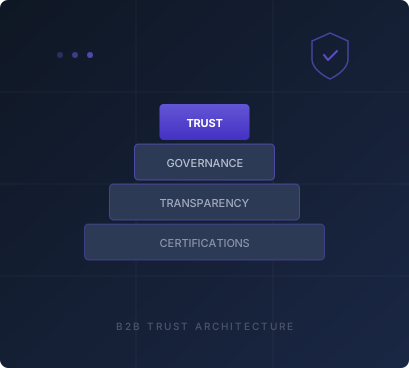
The Trust Architecture Model
Digital trust can be understood as a layered architecture. At the foundation are formal signals of legitimacy. In the middle are operational transparency and accountability mechanisms. At the top stands human reliability and governance stability.
- Foundation: Certifications and compliance
- Operational layer: Transparency and traceability
- Structural layer: Visible governance
- Human layer: Real team
- Outcome: Sustained B2B trust
Trust is cumulative. Each visible signal reduces uncertainty incrementally. Together, they form credibility.
1) Certifications: The Legitimacy Foundation
Certifications remain the most immediate signal of process discipline and regulatory awareness. For Western European buyers, relevant examples include:
- ISO certifications (e.g. ISO 9001, ISO 27001)
- CE conformity (where applicable)
- Industry-specific compliance
- Sustainability and environmental certifications
- Membership in professional associations
However, logos alone are insufficient. Effective certification presentation should include:
- Scope of certification
- Issuing authority
- Validity period
- Downloadable documentation (where appropriate)
- Plain-language explanation of what the certification means operationally
Certifications are not decorative assets. They are formal risk-reduction signals.
"Transparency and accountability of providers are key elements to creating social trust."
2) Transparency: Reducing Perceived Uncertainty
Transparency is not about disclosing everything. It is about eliminating ambiguity. In B2B contexts, ambiguity increases perceived risk.
Practical transparency signals include:
- Clear description of services and scope
- Defined industries served
- Structured pricing logic (ranges or engagement models)
- Easily accessible legal information
- Clear privacy and GDPR statements
- Verifiable contact details and a physical address (where relevant)
In DACH markets, complete legal disclosure is not optional. It is expected. Transparency creates predictability. Predictability reduces risk.
"People, businesses and public administrations will be able to carry out convenient, secure and legally valid electronic transactions across borders."
3) Traceability: Demonstrating Accountability
Traceability is increasingly relevant due to EU sustainability regulation, digital product passport initiatives, ESG reporting expectations and supply chain transparency requirements.
For product-based SMEs (manufacturing, food, industrial supply), traceability can include:
- Batch or serial identification
- QR-based product verification pages
- Timestamped documentation
- Version history of technical documents
- Audit-ready production records
For service providers, traceability may include:
- Documented delivery methodology
- Version-controlled deliverables
- Clearly defined process workflows
- Milestone-based reporting
Traceability signals accountability. It demonstrates that operations are measurable and reviewable. In B2B relationships, accountability is often more persuasive than branding language.
4) Visible Governance: Signaling Stability
Many SMEs under-communicate governance. However, visible governance reduces perceived structural risk. Procurement teams evaluate not only capabilities but organizational stability.
Governance visibility may include:
- Named executive leadership
- Defined management roles (e.g., compliance, quality, security ownership)
- Advisory board (if applicable)
- Corporate structure overview
- Code of conduct
- Ethical or compliance commitments
This does not require corporate-scale complexity. It requires clarity. A website that reveals governance structure communicates seriousness and long-term viability.
5) Real Team: Human Accountability
In cross-border B2B transactions, human visibility is critical. Anonymous teams increase uncertainty. "Stock-photo credibility" is usually counterproductive.
Best practices include:
- Real photography (not stock imagery)
- Defined roles and responsibilities
- Professional biographies
- Verifiable LinkedIn profiles (where appropriate)
- Demonstrated domain expertise and responsibilities
Human accountability strengthens structural trust. It signals that responsibility is identifiable and personal. In Western European business culture, this matters significantly.
From Marketing Asset to Risk Infrastructure
When these five pillars are integrated deliberately, the website transitions from a marketing platform to a risk-reduction system.
This shift is particularly relevant for:
- Export-oriented SMEs
- Industrial suppliers
- Technology service providers
- Sustainability-focused brands
- Companies entering new EU markets
In these contexts, digital presence influences vendor prequalification, partnership eligibility, investment readiness and long-term contract opportunities.
"This harmonisation ensures the recognition and acceptance of digital identity solutions throughout the EU, fostering trust and interoperability."
Strategic Implications for SMEs
For Western European SMEs, the strategic question is not whether to maintain a web presence. The relevant question is:
Does our digital presence reflect our operational maturity?
An underdeveloped website can unintentionally communicate limited compliance awareness, informal processes, weak governance or instability. Conversely, structured digital transparency communicates discipline, accountability, predictability and reliability—core values in Western European B2B markets.
From Concept to Implementation
For many SMEs, the challenge is not understanding the importance of trust. It is structuring it correctly online. Implementing digital trust architecture requires:
- Technical precision
- Regulatory awareness
- Structured information design
- Performance optimization
- Long-term maintainability
This is not primarily a marketing task. It is a systems task. A properly implemented digital presence integrates certification visibility, compliance documentation, traceable data structures, governance clarity and human accountability.
Once implemented, this structure often reveals strategic improvement areas: process gaps, documentation inconsistencies, positioning ambiguity and governance blind spots. In this way, implementation becomes a catalyst for strategic refinement.
The Role of the Implementation Partner
An effective implementation partner does not begin with abstract strategy. They begin with structure:
- Audit existing trust signals
- Identify missing transparency layers
- Design compliant information architecture
- Implement traceability mechanisms
- Ensure performance, accessibility and maintainability standards
Strategy emerges from execution. Trust emerges from structure.
Conclusion: Trust as Competitive Advantage
In increasingly regulated and transparency-driven markets, trust is not abstract. It is engineered.
Certifications establish legitimacy. Transparency creates predictability. Traceability ensures accountability. Visible governance signals stability. Real teams provide human assurance.
Together, these elements form a digital trust architecture that reduces perceived risk and increases partnership readiness—especially in DACH and Western European B2B environments.