Governance Modelling
How SMEs Make Accountability Visible Online for DACH B2B Buyers
From "About Us" pages to operational credibility: a practical implementation guide
Thesis
In Western European B2B markets, governance is interpreted as stability. For SMEs, governance does not mean complex corporate structures. It means clear accountability: who is responsible for what, how decisions are made, how compliance is maintained and how risk is managed.
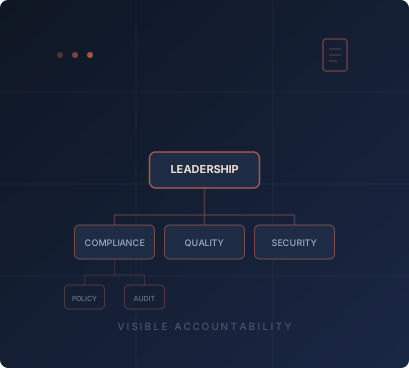
Governance modelling is the process of translating internal accountability into a public, verifiable website structure. Implemented correctly, it reduces procurement friction and increases partnership readiness—especially in DACH.

Why Governance Visibility Matters in DACH
German-speaking B2B environments value predictability, documented processes and clear responsibility. A company that hides governance unintentionally increases perceived risk—even if its delivery quality is high.
What Buyers Infer From Governance Signals
- Stability: Is the company likely to exist and deliver over the contract lifecycle?
- Accountability: Is responsibility identifiable and traceable?
- Compliance discipline: Are obligations treated systematically?
- Risk management: Are incidents handled transparently and professionally?
"Companies are required to identify and address adverse human rights and environmental impacts of their actions inside and outside Europe."
What "Governance" Means for SMEs (Practical Definition)
For SMEs, governance visibility can be achieved with a minimal, structured model:
- Roles: who is responsible (e.g. CEO, Quality Lead, Security Contact)
- Decision pathways: how approvals happen (contracts, changes, exceptions)
- Policies: what rules guide behavior (privacy, security, ethics)
- Controls: how you ensure the rules are followed (audits, reviews, training)
- Evidence: how you prove it (documents, certificates, logs, reporting cadence)
Governance modelling does not require revealing sensitive details. It requires revealing enough structure that buyers can trust the system.
"Greater transparency for citizens, consumers and investors means that businesses can play their full part in society."
How to Implement Governance Modelling on a Website
1) Governance Page (Single Source of Truth)
Create a dedicated governance page that links to: leadership, legal disclosures, policies, certifications and operational commitments. This prevents scattered signals and reduces "trust-search effort."
- Leadership and roles
- Policies and commitments
- Certifications and compliance references
- Risk and incident handling statement
- Contact points (including data protection contact where applicable)
2) Leadership and Accountability (Not Just Titles)
Avoid generic titles without responsibility. Instead, present roles as accountable positions:
- Managing Director / CEO: strategic responsibility, legal representation
- Quality Lead: process standards, QA methodology, supplier quality
- Security / Data Protection Contact: privacy, security controls, incident coordination
- Operations: delivery reliability, escalation path
Include professional bios, location (where appropriate) and verifiable profiles (e.g. LinkedIn).
3) Policies (Readable, Not Legal Theatre)
Policies are a trust signal only if they are readable and operationally meaningful. Minimal recommended set:
- Privacy and data protection (GDPR-aligned)
- Information security statement (even without ISO 27001)
- Code of conduct / ethics
- Supplier standards (if relevant)
- Quality approach (how you ensure consistent delivery)
4) Controls and Evidence
Governance is credible when it references controls and evidence. Examples:
- Internal reviews (e.g. quarterly quality review)
- Training cadence (e.g. annual security training)
- Incident response pathway (how issues are handled)
- Audit readiness (what you can provide under NDA)
Governance Patterns SMEs Can Use
Pattern A: "Lean Governance" (Most SMEs)
- Single governance page
- Named roles (CEO + 1–2 accountable positions)
- Short policy set
- Clear incident and escalation statement
- Evidence available under NDA
Pattern B: "Compliance-Driven Governance" (Regulated or Export-Focused)
- Dedicated compliance and security pages
- Expanded policy library
- Certification presentation with scope and validity
- Structured reporting cadence
- Documented supplier requirements
Pattern C: "Partnership Governance" (Long-Term B2B Contracts)
- Clear service governance model (meetings, KPIs, escalation)
- Defined change management
- Service traceability (milestones, approvals, version history)
- Joint review structure (quarterly reviews)
Common Mistakes That Reduce Trust
- Stock photos instead of real leadership/team
- Policies buried or missing (privacy, legal, security)
- No named responsibilities ("team" without accountable roles)
- Vague language ("we value quality") without controls or evidence
- Outdated documents (expired certifications, stale policies)
- No escalation or incident handling statement
"The CSRD helps investors, civil society organisations, consumers and other stakeholders to evaluate the sustainability performance of companies."
A Practical Implementation Plan (2–4 Weeks)
- Governance inventory: roles, policies, controls, evidence
- Define public vs internal: what to publish, what to keep under NDA
- Information architecture: governance page + linked subpages
- Draft content: readable, structured, compliance-aware
- Publish + validate: consistency checks, accessibility, performance
- Operationalize updates: review cadence for policies and certifications
Governance visibility is only credible if it stays current. The final step is operational: assign ownership and a review schedule.
Conclusion
Governance modelling is not bureaucracy. It is a communication discipline: making accountability visible in a way that procurement and compliance teams can quickly evaluate.
For SMEs selling into DACH and Western European B2B markets, governance visibility reduces perceived risk, increases partnership readiness and improves conversion—without requiring enterprise complexity.